
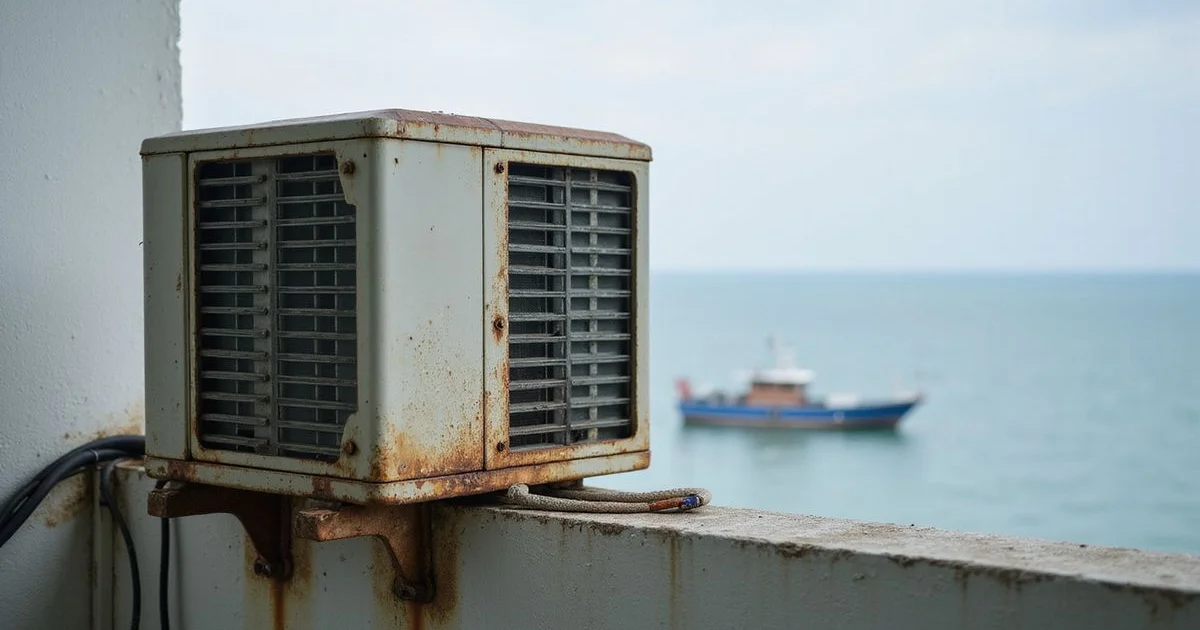
Yes, Sea Air Speeds Up Rust
Homes near the sea in Marine Parade get a steady drift of salty air. That includes the HDB blocks at Marine Terrace, Marine Crescent and Marine Drive, plus condos near East Coast Park. Salt is corrosive. On an aircon outdoor unit, it speeds up rust on the aluminium condenser fins, the metal casing and the mounting bracket.
The compressor and sealed parts are generally protected, but the fins and bracket are exposed. The fins are how the outdoor unit sheds heat, so rust here matters. When they corrode and flake, the unit can’t release heat as well, cooling drops and the system works harder. Keeping up with regular aircon servicing is the simplest way to catch this early.
The outdoor unit takes the worst of it for a simple reason. Salt lands on both coils, but only the outdoor one stays damp. A Marine Parade case write-up from Snowflake Aircon explains that rain and dew keep the fins wet, and salt water between the aluminium fin and copper tube eats the aluminium until it thins, flakes and separates. The indoor coil collects the same salt dry, and it mostly washes off.
The cost can be steep. Emergent Coils, a coil manufacturer, notes that estimates vary, but a condenser coil in a harsh coastal area may lose almost 50% of its performance, or fail within a year. Singapore’s humidity makes it a fair warning for sea-facing flats, even if your unit won’t be that extreme. Since Brian started Cool Earth Aircon in 2007, we’ve seen the same pattern on older sea-facing units: the fins go long before anything inside does.
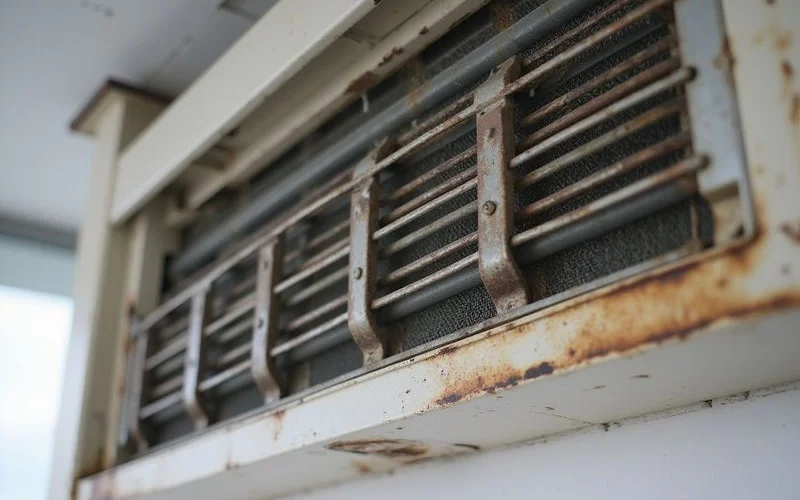
Warning Signs to Look For
Rusted fins, a corroded bracket and cooling that keeps fading are the main signs. You don’t need to climb onto a ledge to spot trouble. Watch for:
- Rusted or flaking fins on the outdoor unit, or orange streaks on the casing
- White, chalky powder on the fins, which is aluminium oxide and a typical sign of galvanic corrosion, according to Sky Blue Aircon
- A corroded or loose bracket, sometimes with rust stains on the wall below
- Weakening cooling that servicing alone does not fully fix
- New rattles or vibration from the outdoor unit, which can point to a weakening bracket
If cooling has dropped, the cause may be the corroded unit or it may be something inside; an aircon not cold check finds out which. New vibration or buzzing from the outdoor unit is worth a noisy aircon repair look, because a loose bracket on a high floor is a safety issue.
Rust streaks running down the wall below the bracket deserve a second look. So do flaking or blistering at the weld points, and hairline cracks in the concrete around the anchor bolts. VD Aircon Services lists these as the signs worth acting on before a bracket becomes a bigger problem.
Please don’t lean out or step onto the ledge to check. Take a photo from a safe spot indoors and send it to us.
What the Technician Checks
On a sea-facing home, the technician looks at the fins, casing and bracket more closely than usual. At every service, the outdoor unit gets this checklist:
- The condition of the condenser fins and whether light corrosion can be cleaned
- The casing and screws for rust
- The electrical connections at the outdoor unit, since salt air can corrode terminals faster than it does inland, as Snowflake Aircon points out
- The bracket and mounts for corrosion, movement or looseness
- Whether a worn bracket should be flagged for replacement before it fails
Light surface rust can often be cleaned and monitored. Heavy corrosion is a different matter, and we will tell you honestly if fins or a unit are near the end of their life.
The bracket check isn’t just good housekeeping. In an HDB flat, the bracket is the flat owner’s responsibility. BCA’s guidance, as summarised by VD Aircon Services, is to have a trained air-conditioning unit installer inspect the supports during routine servicing. The same source says bracket failures in Singapore estates have shown up at 4, 6 and 11 years, so age alone won’t tell you when to worry.
How to Slow It Down
You can’t change the sea air, but you can cut its effect. Keep the outdoor unit serviced on a three to four month cycle so fins are cleaned and rust is caught early. Flag any bracket movement straight away.
Here’s what each step does, and where it stops:
| Step | What it does | Limit |
|---|---|---|
| Regular outdoor unit servicing | Removes salt deposits from the fins before they sit and corrode | Can’t reverse corrosion that has already eaten the metal |
| Gentle, low-pressure rinse | Cleans thin fins without bending them | Harsh chemicals can strip protective coatings, according to Sky Blue Aircon |
| Anti-corrosion fin coating | Adds a barrier against moisture and salt. Emergent Coils says the effect on heat transfer is negligible | Best applied at installation or a heavy service, and won’t fix existing rust |
| Stainless steel bracket | Resists rust far better than cheaper metal | Check the grade. VD Aircon Services puts the SS 201 versus SS 304 price gap at around $40 to $60 per bracket |
If you have 2 to 4 units, check the oldest or the most exposed one first. And if a unit is already heavily corroded, ask about options at the next visit rather than waiting for it to fail on the hottest day of the year. Sea air aircon outdoor unit corrosion is slow, but it rarely reverses on its own. A quick booking now is cheaper than an emergency call later.